
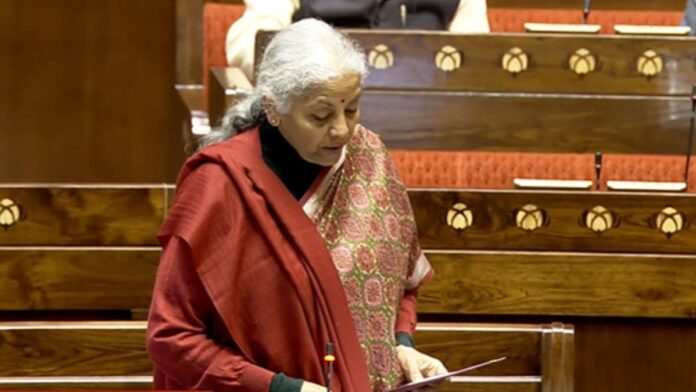
The Economic Survey 2025–26, tabled in Parliament on Thursday, projected India’s GDP growth in the range of 6.8 to 7.2 per cent in the next financial year, slightly lower than the estimated 7.4 per cent growth in the current fiscal, while asserting that the economy remains on a stable footing amid global uncertainty.
Prepared by a team of economists led by Chief Economic Advisor V Anantha Nageswaran, the pre-Budget document said the cumulative impact of policy reforms undertaken in recent years is lifting India’s medium-term growth potential to nearly 7 per cent. It underlined the need for deeper institutional capacity that factors in the geopolitical implications of India’s rising global stature.
Commenting on the sharp depreciation of the rupee in recent months, the Survey said the currency’s valuation does not reflect India’s strong economic fundamentals and described it as “punching below its weight.” It noted that while an undervalued rupee offers some cushion against higher US tariffs on Indian goods and poses no immediate inflationary risk from crude oil imports, it can dampen investor sentiment. The rupee’s weakness, it added, is largely a result of foreign capital flows drying up.
The Survey stressed that a strong and stable currency is a natural corollary of India’s aspiration to become a developed nation under the ‘Viksit Bharat’ vision and to enhance its global influence.
On inflation, the document pointed to a subdued core inflation trajectory, indicating strengthening supply-side conditions across the economy. It also said the central government remains on track to meet its fiscal consolidation roadmap, targeting a fiscal deficit of 4.4 per cent of GDP in 2025–26. As of November 2025, the fiscal deficit stood at 62.3 per cent of the Budget Estimates.
“Markets have acknowledged and rewarded the government’s commitment to fiscal discipline through lower sovereign bond yields, with the spread over US bonds declining by more than half,” the Survey noted.
Despite higher tariffs imposed by the United States, India’s merchandise exports grew by 2.4 per cent during April–December 2025, while services exports rose by 6.5 per cent. Merchandise imports increased by 5.9 per cent during the same period. The current account deficit remained moderate at 0.8 per cent of GDP in the first half of FY26, aided by strong remittance inflows, which in most years have exceeded gross FDI inflows.
The Survey said global uncertainty has been reshaped by geopolitical realignments affecting investment flows, supply chains and growth prospects, and called for prioritising domestic growth while building adequate buffers and liquidity. It maintained that there is “no space for pessimism,” though caution is warranted given the possibility of multiple global crises.
On trade, the document said India must enhance its competitiveness to fully realise the benefits of free trade agreements. It noted that the proposed FTA with Europe would strengthen manufacturing competitiveness, export resilience and strategic capacity.
The Survey also included a dedicated chapter on artificial intelligence, warning that overly optimistic asset valuations could correct sharply if the AI boom fails to deliver expected productivity gains.
Highlighting sectoral trends, it said India’s civil aviation sector is on a sustained growth path supported by rising demand, infrastructure expansion and a conducive policy environment. While India has become the world’s third-largest domestic aviation market, passenger volumes still represent only a fraction of the sector’s potential.
The document also pitched for policy interventions to reshape the terms of work for gig and platform workers, recognising their growing role in the economy.