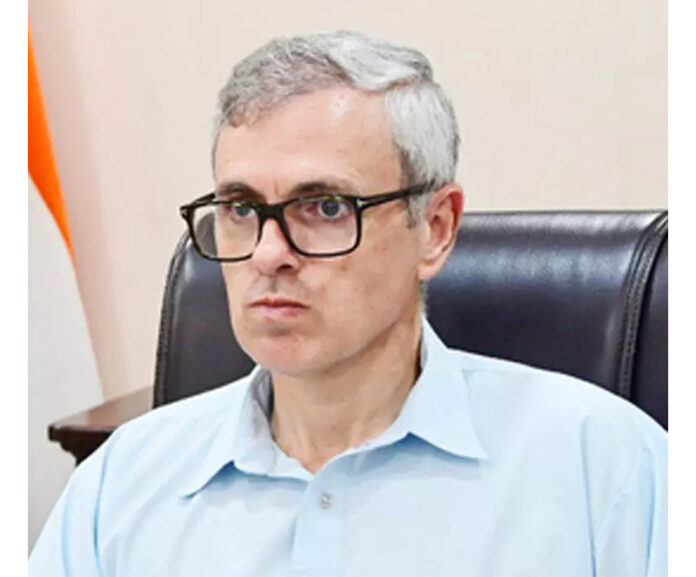
Jammu and Kashmir Chief Minister Omar Abdullah has urged Bihar Chief Minister Nitish Kumar to apologise to a woman doctor whose veil he controversially pulled down during a government function in Patna. The incident ignited a firestorm of criticism, highlighting significant concerns over respect and dignity in public interactions.
This unsettling event unfolded on Monday at the Bihar Secretariat during a ceremony for distributing appointment letters to AYUSH doctors. Witnesses reported that Kumar questioned the woman’s attire by asking, “What is this?” before pulling down her naqab.
“There is no justification for touching a woman’s clothing in this manner. Such an act is simply unacceptable,” Abdullah stated emphatically while addressing reporters in Jammu. He further expressed dismay over the doctor’s response, revealing that she has reportedly declined her appointment letter and decided not to join government service.
Abdullah passionately asserted that Kumar must publicly apologise not only to the doctor but also encourage her to resume her career within the government framework.
Inkling of political tensions surfaced when Abdullah responded to Union Minister Giriraj Singh, who defended Kumar’s actions. “Expecting support from the BJP party for this behavior is unreasonable,” Abdullah remarked. He contrasted the incident, stating, “If a Muslim leader had engaged similarly with a Hindu woman in Haryana or Rajasthan, the outcry would have echoed through the country. Yet, because this involves a Muslim woman, the issue goes unnoticed by the BJP.”
He drew attention to a crucial aspect of the debate, insisting the matter revolves around respect for women and their dignity, not merely religious affiliations. “How can anyone justify touching a woman’s veil? What prompted the Chief Minister to act in such a manner?” Abdullah pressed, demanding Kumar recognise his error.
Abdullah on Political and National Issues
Diving into broader political matters, Abdullah also addressed remarks made by Congress leader Prithviraj Chavan regarding the military engagements with Pakistan. Chavan had commented on a supposed failure during the initial phase of Operation Sindoor. Abdullah clarified that it represented Chavan’s individual perspective rather than an official position of the Congress party.
“The Congress and other opposition forces solidly stood with the government and the armed forces following the terror attack in Pahalgam. We must unite during such critical times,” Abdullah stressed.
The ‘Idea of India’
Omar Abdullah’s visit coincided with the 11th edition of the India’s International Movement to Unite Nations (IIMUN) Role Model Series, where he elaborated on the “idea of India” and Jammu and Kashmir’s unique historical choice to accede to India. “In a tumultuous period during the Partition, Jammu and Kashmir, a Muslim-majority state, could have aligned with Pakistan, given its geographical proximity. Instead, we chose to join India. This choice embodies the essence of the unity we must sustain,” he asserted, advocating for the idea of a pluralistic society.
He acknowledged that while perspectives on India’s essence may differ, the pillars of democracy and majority rule should allow for respectful debate, even amid apprehensive developments.
Merit Over Religion
Pursuing a forward-looking vision, Abdullah directly challenged communal narratives regarding merit and identity in education and sports within Jammu and Kashmir. He referred to a recent uproar that followed the admission of 42 Muslim students among the 50 in the first MBBS batch of Vaishno Devi Medical College via NEET, alongside discussions about the selection of the J&K football team for the prestigious Santosh Trophy.
“The focus should shift solely towards merit, distinguishing between the talented and the rest,” he remarked decisively. “In the future I envision for our children, religion should play no role in determining one’s success. Achievement in examinations and sports should solely reflect capabilities, not religious affiliations.”