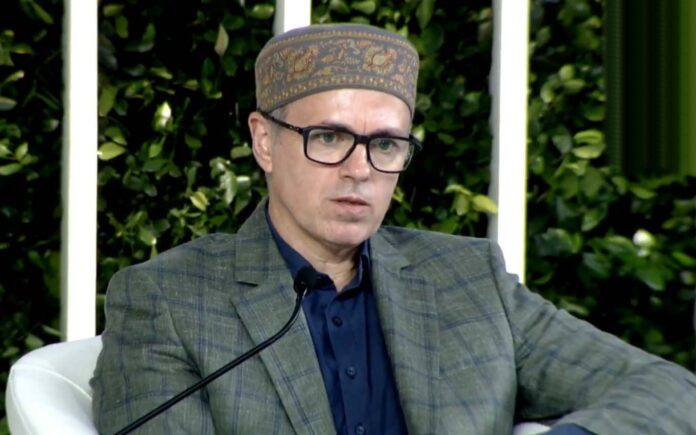
Jammu and Kashmir Chief Minister Omar Abdullah recently described his office as one of “disempowerment.” During a public event organized by a national newspaper, he expressed the unique challenges he faces, having transitioned from leading an empowered state to managing a Union Territory with significantly reduced powers.
Abdullah stressed the pressing need for a clearly defined timeline for restoring statehood during his address. He voiced concerns about regular interference from the Lieutenant Governor’s office, suggesting it undermines the authority of locally elected officials.
“I find it very difficult to reconcile the terms ‘Union Territory’ and ‘Jammu and Kashmir’ in the same sentence,” he remarked. Abdullah added that the term ‘Union Territory’ now dominates conversations, contrasting sharply with the autonomy he experienced during his previous tenure.
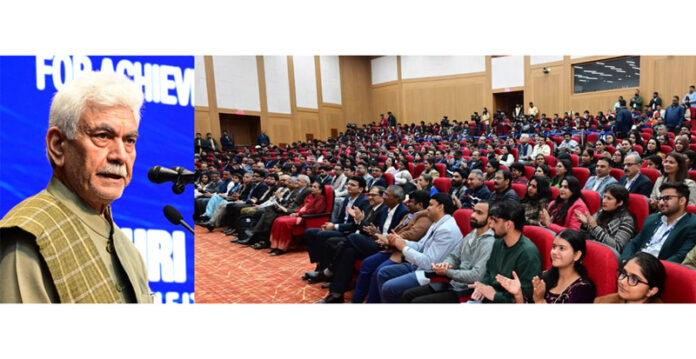
Abdullah criticized the power dynamics between the Lieutenant Governor, Manoj Sinha, and the elected government. He pointed out that the Lieutenant Governor continues to undertake roles typically reserved for an elected administration, such as leading meetings related to tourism.
“What business does someone responsible for security have holding a tourism meeting?” Abdullah questioned critically. His comments underscore a significant power struggle between elected representatives and the appointed bureaucratic leadership in Jammu and Kashmir.
The Chief Minister further highlighted the appointment of an IAS officer to a role designated for the Jammu and Kashmir Administrative Services (JKAS). He viewed this as a tactic by the central government to dilute local governance and restrict the elected government’s control over the Information Department.
Abdullah noted several cabinet decisions, including adjustments to reservation percentages, are still pending approval from the Lieutenant Governor. “There is an asymmetrical allocation of power between the elected and unelected government,” he stated firmly.
Regarding the long-awaited restoration of statehood, Abdullah reminded the Centre of the outlined three-step process involving delimitation, elections, and statehood restoration. “Two steps are complete. Why are we made to wait for the third?” he challenged.
Addressing the restoration of Article 370, he asserted that it would only be reestablished following a change of government at the Centre. “It is pointless to ask those who took it away from us to give it back,” he said firmly, emphasizing the importance of representing the interests of the people.
Abdullah further warned that “hyper-nationalism” and punitive measures against communities contribute to rising radicalization. He condemned practices such as demolishing homes following terror attacks, illustrating this with a recent incident in Pahalgam where homes were destroyed despite no local involvement being detected.
“If those people are radicalized, whose fault is it?” Abdullah asked, pointing towards the heavy-handed approach taken by authorities.
He also touched upon recent controversies involving sports teams and medical college admissions, highlighting issues arising from perceived biases against the majority Muslim population in these sectors. “When you push an entire community to the margins, how can you expect no reaction?” he queried.
Shifting focus to national politics, Abdullah expressed concern regarding the current state of the alliance known as the INDIA Bloc, suggesting it frequently resides in the “ICU” or relies on “ventilator support.” The debate surrounding the significance of Article 370 has notably shifted from its core agenda.
He defended Congress leader Rahul Gandhi’s reticence on the issue, emphasizing practicality over principle. “I’d like him to win an election first before I can have this conversation,” he noted, arguing that raising such a contentious issue might jeopardize electoral prospects in the current climate.
Abdullah diverged from his father’s stance regarding electronic voting machines (EVM), asserting that while his father believes in potential tampering, he believes in accepting electoral outcomes and correcting past mistakes rather than attributing losses to conspiracy.
On economic matters, Abdullah highlighted pressing environmental challenges such as pollution in Srinagar. He urged attention to the valley’s geographical challenges that aggravate air quality issues.
Furthermore, he corrected misconceptions regarding the economy of Jammu and Kashmir, stating that tourism is not the sole economic driver. He pointed out that tourism ranks fourth in contribution to the Gross State Domestic Product after agriculture, horticulture, and industry, emphasizing a need for a diverse economic approach.