The last rites of veteran Congress leader and former Union Minister Shivraj Patil occurred with full state honours on Saturday, as the nation bid farewell to one of its most influential parliamentarians. The funeral took place in his hometown of Latur, Maharashtra, attended by senior leaders across party lines.
Notable attendees included Lok Sabha Speaker Om Birla, Congress President Mallikarjun Kharge, and Union Minister of State for Defence Sanjay Seth. Former Maharashtra Chief Minister Ashok Chavan and Karnataka Minister Eshwar Khandre also paid their respects.
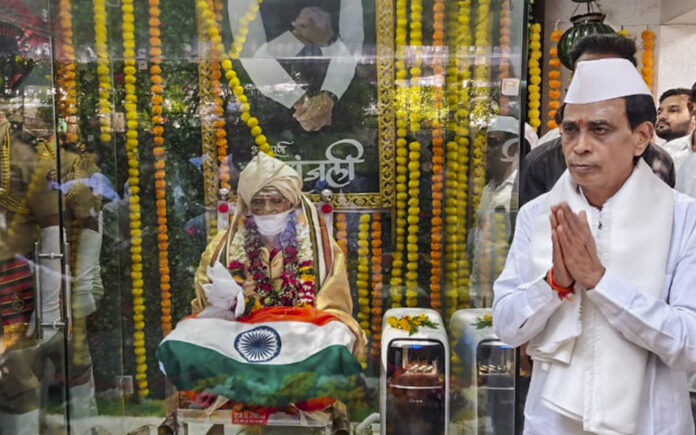
Patil, a prominent leader of the Lingayat community, was buried at his farm in Varvanti village, six kilometres from Latur. The burial adhered to traditional Lingayat rites, with Patil laid to rest in a seated, meditative position, reflecting the belief that the soul merges with Lord Shiva after death.
Prior to the burial, leaders conducted a ceremonial gun salute, with Speaker Om Birla laying a wreath on Patil’s mortal remains. The ceremony highlighted the respect and admiration for Patil across the political spectrum.
Shivraj Patil, aged 90, passed away on Friday following a brief illness, leaving behind a remarkable legacy. His political journey spanned over five decades, and he held several key roles, including Speaker of the Lok Sabha and Union Home Minister.
Patil began his public career in 1967 as a member of the Latur Municipal Corporation and served two terms in the Maharashtra Legislative Assembly between 1972 and 1980. From 1980 onwards, he represented the Latur Lok Sabha constituency for an impressive seven consecutive terms, winning elections in 1980, 1984, 1989, 1991, 1996, 1998, and 1999.
Initially, he joined the Indira Gandhi government as Minister of State for Defence (1980–82), before leading the Commerce Ministry (1982–83). He later headed portfolios including Science and Technology, Atomic Energy, Electronics, Space, and Ocean Development (1983–84).
During the Rajiv Gandhi administration, Patil took on critical roles, including Minister for Personnel, Defence Production, and Civil Aviation. He became the Union Home Minister in 2004 and held this position until November 30, 2008, resigning due to moral responsibility over security lapses during the 26/11 Mumbai attacks.
From 2010 to 2015, he served as the Governor of Punjab and Administrator of Chandigarh, further solidifying his esteemed political presence.
Patil was revered for his commitment to parliamentary integrity. A defining moment in his career emerged in March 1979 when unverified reports suggested that the acclaimed Gandhian leader Jayaprakash Narayan had died. While many leaders, including Prime Minister Morarji Desai, expressed their condolences, Patil demanded official confirmation.
This dedication to accuracy led him to contact Narayan’s doctors and verify his wellbeing, demonstrating his commitment to integrity. The Assembly subsequently passed a resolution wishing Narayan a long life, who sadly passed away months later, in October 1979.
Shivraj Patil’s death marks the end of an era characterized by respect, decorum, and significant political contributions. His legacy will continue to inspire many in Indian politics.