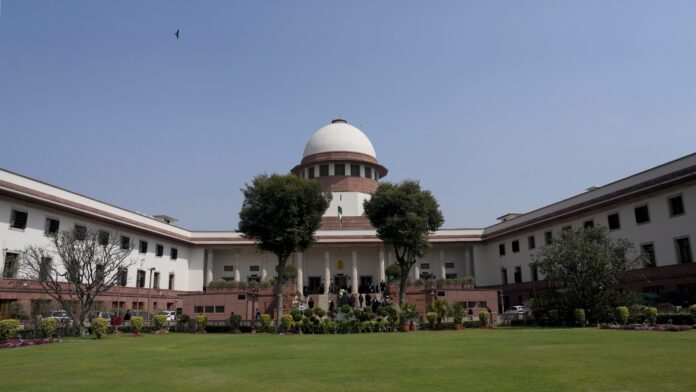
The Supreme Court on Tuesday asked the chief priest of the Sabarimala Ayyappa Temple if the Constitution will not come to the rescue of a believer who is not allowed to touch the deity.
The remark by the top court came after the chief priest said that when a devotee goes to a temple for worship, it can’t be in antagonism to the characteristics of a deity.
The nine-judge Constitution bench is hearing petitions related to discrimination against women at religious places, including the Sabarimala Temple in Kerala, and on the ambit and scope of the religious freedom practised by multiple faiths.
The bench comprises Chief Justice Surya Kant and justices B V Nagarathna, M M Sundresh, Ahsanuddin Amanullah, Aravind Kumar, Augustine George Masih, Prasanna B Varale, R Mahadevan, and Joymalya Bagchi.
Appearing for the ‘thantri’, senior advocate V Giri submitted that the nature of ceremonies and rituals followed in any temple forms the integral part of the religion and therefore is a religious practice.
He said continuance of such practice, which is an essential religious practice, would be a part of the right to worship that is for every member who believes in the religion or religious denomination.
“When a devotee goes to a temple for worship, it can’t be in antagonism to the characteristics of a deity because its for the purpose of worshipping the deity. The devotee surrenders to the divine spirit contained in the deity. He/she has to accept the essential characteristics of the deity,” Giri said.
Posing a question, Justice Amanullah asked, “When I go to a temple, my fundamental belief is that he is the Lord, he is my creator, he has created me, right? “I go there with one hundred percent belief. I am totally devoted, absolutely nothing impure in my heart. And there, I am told that because of a birth, a lineage, a certain situation, permanently you are not allowed to touch the deity. Now, will the Constitution not come to the rescue? Justice Amanullah remarked, adding that there cannot be a difference between the creator and creation.
Giri replied that if there is a complete ban on anybody becoming a priest, then that will be taken care of either by a Article 25(2)(b) legislation or it will be taken care of by the State itself.
“If priest means the person who is instructed in the ‘Shastras’ as to how to conduct worship and how to worship the deity, if there is a complete ban on any person becoming a priest and then doing the ‘seva’, as we call it, only by reason of birth, that will be taken care of either by a Article 25(2)(b) legislation or it will be taken care of by the State itself,” he said.
The senior lawyer said “Naishtika Brahmachari” (perennial celibate) can be considered as an essential characteristic to the deity and the ceremonies and rituals performed in Sabarimala are in synchronisation with the concept. “I have a right to practice my religion under Article 25 of the Constitution…If the characteristics of the deity are as such that its not possible for me to go there, if I am a woman, it has to be in sync with the characteristics of the religion. The characteristic of the deity in sofar as Sabarimala is concerned contemplates that the deity is a permanent celibate,” Giri said.
He contended there is a total lack of material on the part of the writ petitioners to show that the concept of “Naishtika Brahmachari” pleaded by the petitioner are either ill founded, misconceived, or doesn’t form the essential form of the religion.
The hearing is underway. Observing that denominational practices can be subject matter of judicial scrutiny, the top court on April 17 had said that judges must rise above personal religious beliefs and be guided by freedom of conscience and the broader constitutional framework while adjudicating matters of faith. In September 2018, a five-judge Constitution bench, by a 4:1 majority verdict, lifted the ban that prevented women between the ages of 10 and 50 from entering the Sabarimala Ayyappa Temple and held that the centuries-old Hindu religious practice was illegal and unconstitutional.
Later, on November 14, 2019, another five-judge bench headed by the then CJI Ranjan Gogoi, by a majority of 3:2, referred the issue of discrimination against women at various places of worship to a larger bench. (Agencies)