
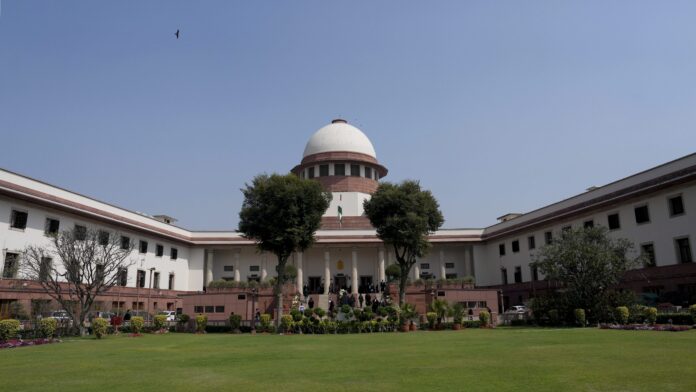
The Supreme Court on Monday upheld an order of the National Green Tribunal (NGT) holding that a landlord cannot be held liable for environmental violations allegedly committed by a tenant operating an industrial unit on rented premises.
A bench comprising Justices Satish Chandra Sharma and Sanjeev Sachdeva declined to interfere with the NGT’s November 14, 2025 order, effectively dismissing a challenge filed by the Gujarat Pollution Control Board (GPCB).
The case arose from proceedings initiated by the GPCB against a chemical manufacturing unit operating in Surat. The pollution control authority had imposed an interim environmental damage compensation of Rs 25 lakh after inspections revealed that effluent discharged by the unit exceeded permissible pollution limits.
The industrial unit, engaged in dye-intermediate manufacturing, had also been operating without fulfilling mandatory regulatory requirements, including obtaining the necessary consent to establish from the pollution control authorities. Following these findings, the GPCB issued a closure order on October 16, 2023, and imposed the environmental compensation.
However, the penalty was also extended to the property’s owner, Jagmohan Lachiram Jalan, who challenged the decision. Jalan contended that he had leased the premises in 2020 to the director of a private company under a valid rental agreement and was unaware that the tenant was operating an unlicensed industrial unit.
He further submitted that upon learning about the alleged violations, he lodged a police complaint against the tenant. Subsequently, he approached the Gujarat High Court, which directed the GPCB to reconsider his representation.
Despite the High Court’s direction, the pollution control board upheld the penalty against Jalan in 2024. Aggrieved by the decision, he approached the National Green Tribunal.
The NGT ruled in Jalan’s favour, observing that there was no material to establish that the landlord had any role in the environmental violations committed by the tenant. Consequently, the Tribunal set aside the Rs 25 lakh compensation imposed on him.
Challenging the Tribunal’s decision, the GPCB moved the Supreme Court. However, the apex court found no reason to interfere with the NGT’s findings and upheld the Tribunal’s order, reinforcing the principle that liability for environmental violations must be based on actual involvement and responsibility rather than mere ownership of the premises.
The ruling is expected to have significant implications for landlord liability in cases involving environmental compliance and industrial operations conducted by tenants.