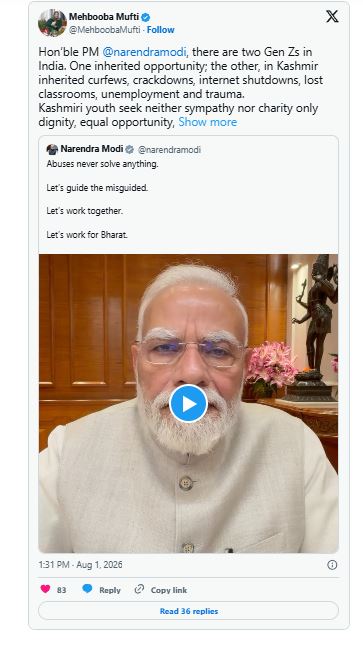
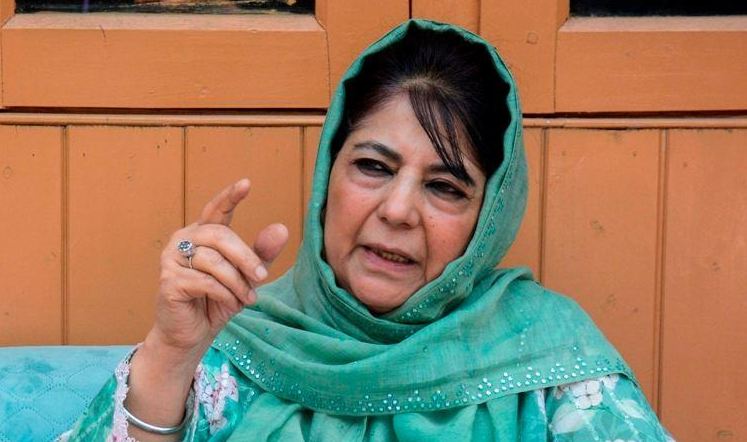
Peoples Democratic Party (PDP) chief Mehbooba Mufti raised significant concerns about the plight of youth in Kashmir in response to Prime Minister Narendra Modi’s recent video on platform X. In her statement, Mufti drew attention to a critical discrepancy, stating that there are two distinct Generation Zs in India. One benefits from inherited opportunities, while the others, particularly in Kashmir, endure inherited curfews and trauma.
Mufti spoke out against Modi’s call for forgiveness towards students who used profanity during a protest at Jantar Mantar. She argued that the youth of Kashmir do not seek mere sympathy or charity; rather, they demand equal opportunity and recognition. Her assertion underscores a yearning for dignity and freedom to aspire without fear.
“Hon’ble PM @narendramodi,” Mufti tweeted, “there are two Gen Zs in India. One inherited opportunity; the other, in Kashmir, inherited curfews, crackdowns, internet shutdowns, lost classrooms, unemployment and trauma.” Her words reflect a deep-seated frustration with the ongoing issues faced by the youth in the valley.
She emphasized that Kashmiri youth deserve political space and the right to pursue their dreams. “If compassion is to define India’s future, let it begin with Kashmir,” Mufti urged, highlighting the urgent need for governmental attention and action.
This discourse draws attention to the wider context of youth issues across India, as well as the unique challenges faced in conflict-affected areas like Kashmir. The government’s approach to reconciliation and addressing grievances remains a crucial topic in public discourse.
Indeed, the stark contrast Mufti highlights raises questions about how opportunities are distributed across the country. In a nation characterized by diversity, the disparity in the lived realities of different groups poses a challenge to national unity and equitable development.
As more voices join the conversation about youth empowerment, the implications of Mufti’s comments resonate widely with many demographics feeling similarly disenfranchised.
In retrospect, her observations spotlight a need for introspection and constructive dialogue about the future of young people in India, particularly those from marginalized communities.