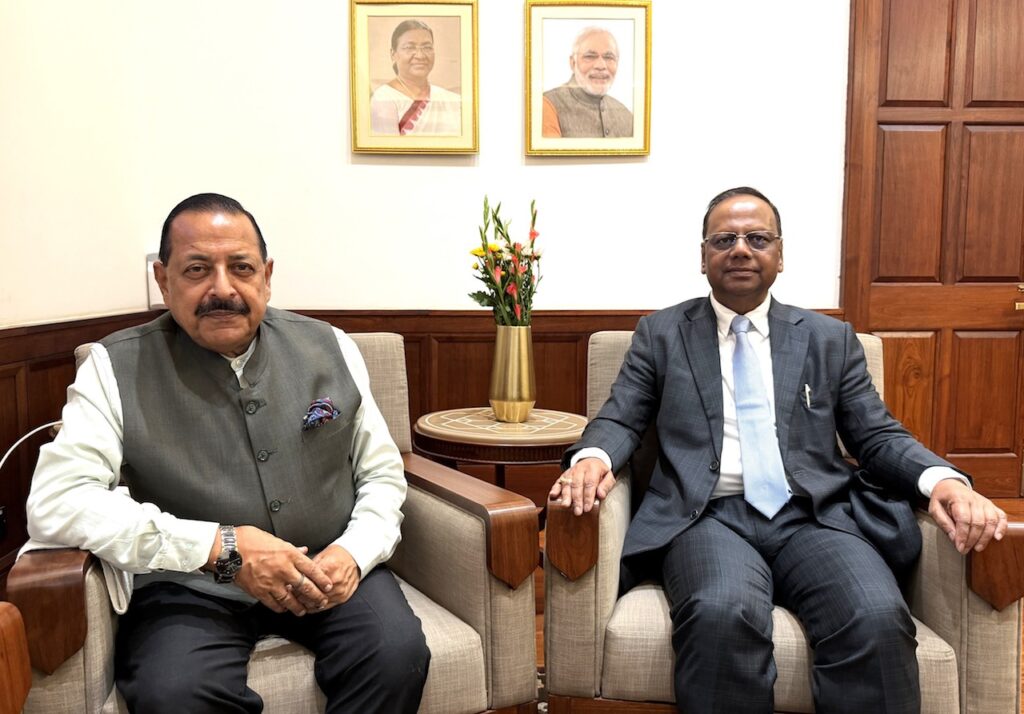
Justice Ranjit Vasantrao More, the Chairman of the Central Administrative Tribunal (CAT), recently met Union Minister of State Dr. Jitendra Singh to discuss significant reforms and the Tribunal’s impressive case disposal rate. The CAT’s initiatives aim to enhance administrative justice through technology, outreach, and institutional changes.
Justice More informed Dr. Singh that the tribunal has received over 10 lakh cases since its establishment. Out of these, it has successfully disposed of more than 9.32 lakh cases, achieving an impressive overall disposal rate of over 93%.
Dr. Jitendra Singh emphasized that the government, under the leadership of Prime Minister Narendra Modi, strives for transparency and efficiency in public institutions. He remarked that administrative justice forms the backbone of good governance and must evolve to enhance accessibility and efficiency for government employees across India.
The Minister noted that modern technology drives the transformation of public institutions. Digital platforms significantly improve service delivery, enhance accountability, and diminish procedural delays. This innovation makes governance more responsive to citizen’s needs.
Highlighting the CAT’s progress, Dr. Singh praised efforts to expand its digital ecosystem, infrastructure improvements, and the growing efficiency in case disposal. These advancements contribute to a more robust administrative justice system, aligning with the broader governance reforms championed by the government.
Dr. Singh maintained that expanding access to justice remains a key government priority. Establishing new Benches and launching Circuit Sittings in distant regions have brought administrative justice closer to litigants, alleviating the need for extensive travel for government employees.
He stated that meaningful institutional reforms yield measurable outcomes. The increase in case disposal rates and modernization of judicial processes reflect the impact of sustained technology-backed reforms and upgraded administrative systems.
Justice More outlined several initiatives undertaken in recent years, including the establishment of new Benches in Jammu and Srinagar and Circuit Sittings at places like Puducherry, Leh, Kargil, and Vijayawada. These measures significantly expand access to administrative justice for individuals in underserved areas.
He also reported on the substantial advancements achieved under the Advanced Case Information System (ACIS), which incorporates digital services such as e-filing, virtual hearings, SMS alerts, and mobile applications, facilitating a paperless court environment.
Dr. Jitendra Singh reaffirmed that these initiatives fully reflect the government’s vision of Digital India. He reinforced the notion that technology plays an essential role in promoting transparency and efficiency in governance.
During their meeting, Justice More reiterated that the Tribunal, since its inception, has managed to maintain high disposal rates amid a sustained influx of new cases, significantly reducing backlogs. In fact, annual disposals in 2025 surpassed the number of new cases initiated.
The Chairman further discussed implementations such as e-Office across all Benches, onboarding on e-HRMS, and digital processing of pension cases through the Bhavishya Portal. These advancements signify the Tribunal’s dedication to digital governance.
Dr. Singh concluded that the government will continue to champion reforms aimed at improving institutional capacity, public service delivery, and efficient, accountable, citizen-centric institutions. He stated that the ultimate goal is to ensure that these governance reforms deliver tangible benefits for employees and citizens across the nation.