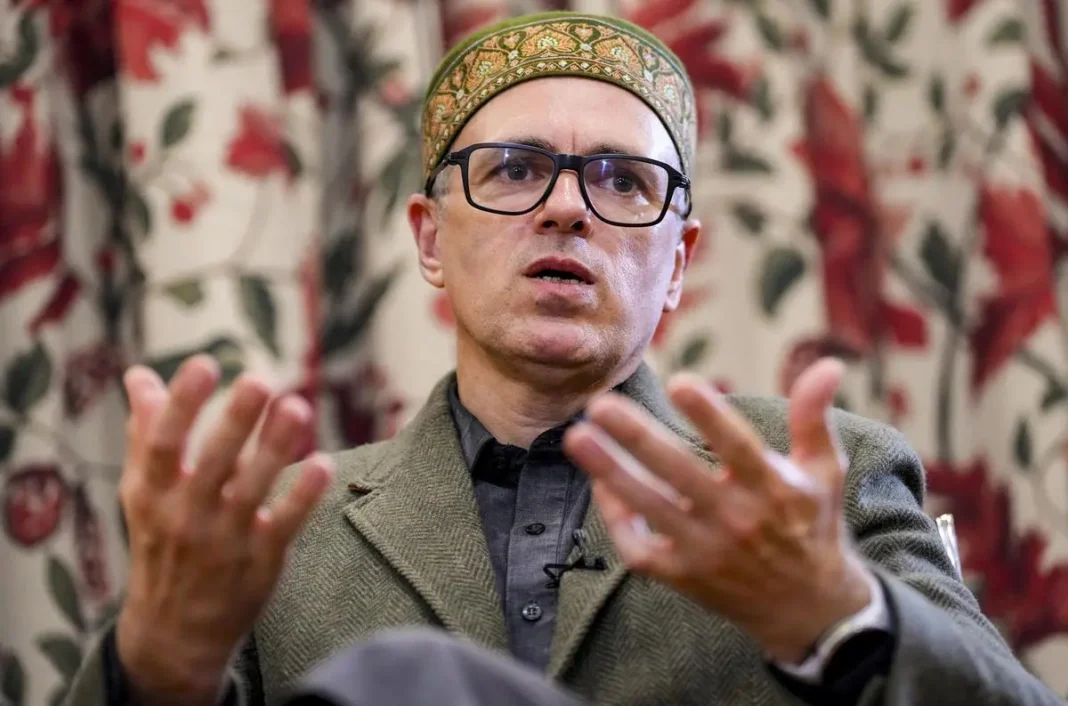
On Friday, Jammu and Kashmir Chief Minister Omar Abdullah firmly stated that the Tamil Nadu governor should allow TVK leader Vijay to prove his majority in the state assembly. Abdullah’s remarks came after the governor rejected Vijay’s claim to form the government, asserting that his party did not possess the necessary numbers.
Governor Rajendra Vishwanath Arlekar denied TVK’s request on Thursday, pointing out the party’s inability to reach a simple majority needed to govern Tamil Nadu. With 234 seats in the assembly, TVK falls short despite receiving support from the Congress party, which holds five seats, leaving Vijay’s party with insufficient numbers to meet the 118-seat majority requirement.
Addressing reporters, Abdullah emphasized there was no justification for the imposition of President’s rule in Tamil Nadu, referencing various Supreme Court judgements that advocate for inviting the single largest party to form a government and subsequently prove its majority.
“The Supreme Court has repeatedly ruled that after elections, the largest party should be invited to form the government and should be allowed to demonstrate their majority in the assembly,” Abdullah asserted. He cited the historical example of former Prime Minister A B Vajpayee, who briefly led a government without a clear majority, underscoring the importance of allowing Vijay the same chance.
“If we adhere to the Supreme Court’s interpretation of this process, then the Tamil Nadu Lok Bhavan has no justification to obstruct this procedure,” he added.
Omar Abdullah reiterated that by giving Vijay the opportunity to form the government, it allows for a clear demonstration of legislative support, stating, “Vijay should be allowed to form his government, and then it is crucial he proves his majority. If he does succeed, he can continue leading; if not, he will need to resign.”
The ongoing political tension in Tamil Nadu has sparked discussions about the appropriate protocols concerning government formation and the role of the state governor, making this a significant event in India’s political landscape.