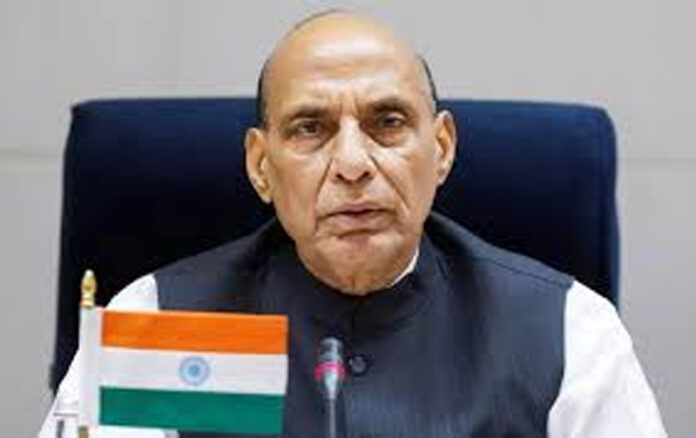
Defence Minister Rajnath Singh on Tuesday said Operation Sindoor demonstrated how indigenous defence systems are strengthening India’s operational readiness, underlining the crucial role played by the Defence Research and Development Organisation (DRDO) in advancing self-reliance, which he described as a “national mindset” under Prime Minister Narendra Modi’s leadership.
Addressing a gathering at a DRDO event here, Singh stressed that in an era of rapid technological change—particularly on the battlefield—India must prioritise speed in innovation and deployment. “Today, especially in warfare, we must think in terms of ‘survival of the fastest’, not just ‘survival of the fittest’. The country that thinks, decides and deploys technology quickly stays ahead,” he said.
Singh highlighted the need to significantly reduce the time lag between research and prototype development, testing and eventual deployment, asserting that timely induction into the armed forces should be the primary benchmark of success.
Referring to Operation Sindoor, the defence minister said DRDO-developed technologies were effectively used during the operation, underscoring the organisation’s role in the rapid transformation of India’s defence sector driven by indigenisation. DRDO-made platforms were deployed by Indian forces during the decisive military action in May 2025.
India launched Operation Sindoor on May 7 in response to the Pahalgam terror attack, carrying out air strikes on terrorist infrastructure in Pakistan-controlled territories. The strikes led to four days of intense military exchanges, which ended with an understanding to halt hostilities on May 10.
Singh urged the DRDO to move beyond areas where the private sector has already built strong capabilities and suggested creating a separate wing within the organisation to take calculated risks in emerging and high-uncertainty domains. “If success is achieved in such sectors, the outcome will be historic,” he said.
Calling for deeper collaboration, Singh emphasised the need to bridge the gap between design, prototyping and production. He advocated a co-development model, with industry involvement from the early stages of system design through production, drawing parallels with international best practices.
He cited the Light Combat Aircraft Tejas as a successful example of collaboration between the DRDO and Hindustan Aeronautics Limited, and said many more such achievements were possible if the DRDO worked closely with public sector undertakings, private industry, MSMEs, start-ups and academia. “Government support will be meaningful only when the DRDO moves from a monopolistic R&D model to a collaborative ecosystem,” he said.
Highlighting the growth in defence exports, Singh said exports had risen from less than Rs 1,000 crore in 2014 to nearly Rs 24,000 crore at present. He reiterated the government’s target of achieving defence exports worth Rs 50,000 crore by 2029–30, and urged the DRDO to factor in export potential from the design stage, particularly in areas such as drones, radars, electronic warfare systems and ammunition.
Focusing on human capital, Singh described scientists, engineers and technicians as the real strength of the DRDO and stressed the need to provide them with learning opportunities, leadership roles and an environment where innovation is encouraged. “Failures are a part of research, and we must learn from them,” he said.
On the occasion, Singh presented awards under the DRDO Award Scheme 2024. A book titled ‘The Unprecedented Success Story of the First Indigenous Supersonic Multi-Target Surface-to-Air Missile System — AKASH’ was also released.